Got a Reason for Living Again Mp3 Agape Force
Air Date: Week of August 27, 2021
stream/download this segment every bit an MP3 file
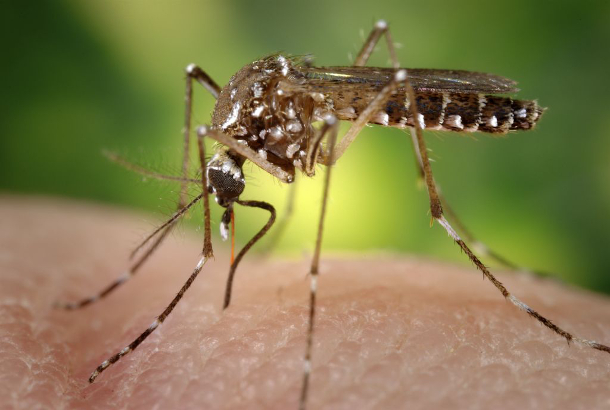
Dengue virus is spread through the seize with teeth of an infected mosquito. Co-ordinate to the CDC, 40% of the world's population live in areas with a risk of dengue. (Photo: Sanofi Pasteur, Flickr CC BY-NC-ND 2.0)
Mosquitoes acquit diseases like malaria, Zika, and dengue fever that kill more than a million people every year. In a breakthrough study, scientists released mosquitoes infected with a special kind of leaner into an Indonesian city and saw a 70% drop in dengue cases. World Musquito Program Founder Scott O'Neill joins Host Jenni Doering to talk about how the Wolbachia bacteria tin can reduce transmission of dengue virus and save lives.
Transcript
[MOSQUITO Buzz SFX]
DOERING: They're non just annoying. Mosquitoes are the most efficient disease transmitters on the planet, killing more than 1 one thousand thousand people every yr co-ordinate to the World Health Organization. But a tiny and unlikely hero could assist in the fight against diseases like zika virus and yellow fever. It'south a type of bacteria chosen Wolbachia, and it makes mosquitoes much less probable to carry and transmit affliction. Scientists at the Earth Mosquito Programme recently reached a breakthrough in a trial that used Wolbachia to try to combat the virus that causes dengue fever. They released mosquitoes infected with Wolbachia into parts of an Indonesian urban center and saw a huge drop in dengue cases in those neighborhoods. Scott O'Neill is the founder of the Earth Mosquito Plan and joins me at present from France. Welcome to Living on Earth!
O'NEILL: Hi, it's a pleasure to exist here with yous.
DOERING: And then tell me about how y'all and your colleagues adult this technique of using the Wolbachia bacteria to combat dengue fever.
O'NEILL: Aye, so I was very interested in the properties of Wolbachia, which enabled it to be able to spread into a wild mosquito population and maintain itself. And we spent a lot of time working out how to transfer Wolbachia into mosquitoes. So it was stably maintained. When we got it into the mosquitoes, nosotros found out by chance that it really prevented a range of viruses from growing, replicating in the body of the mosquito, and they tin can't abound in the trunk of the mosquito, they can't be transmitted to people: dengue fever, Zika, chikungunya, yellow fever, all these viruses transmitted by the same mosquito couldn't grow.
DOERING: How does this Wolbachia bacteria actually button out the viruses?
O'NEILL: Yes, so what it does is it stops them from replicating. And we remember it'due south doing that in a couple of different ways. Most importantly, it's competing for central resources that the virus needs to be able to produce more copies of itself. And as a upshot, the virus doesn't grow besides, if this Wolbachia is in the insect, and if it doesn't abound, and then it can't get spat out once more when it bites somebody in its saliva, which is how people get the virus transmitted to them. So it's a natural mode in which we tin completely finish transmission of a whole range of viruses simultaneously.
DOERING: Correct. So this is a really common bacterium in nature, but it wasn't already in mosquitoes.
O'NEILL: That's right. So it occurs naturally, nosotros estimated effectually 50% of all insects and bees, or butterflies, all sorts and including a number of mosquitoes. But it didn't occur in this i mosquito that transmits all these viruses to people. And so the piece of work of my laboratory for many years was involved in transferring it into that mosquito and then that it would maintain itself in that location, which we were ultimately successful at doing.
DOERING: How did yous tweak it over the years?
O'NEILL: Oh, yous know, it's, it's a long and complicated story that took united states many years of dissimilar approaches of, yous know, at the cease, we needed to inject it into musquito eggs that have been laid and handled in a certain way with certain needles with preparations of or Wolbachia extracted from a fruit fly. And took us many, many years. Just one time we had done at once, we were able to have a colony of mosquitoes and with the discovery that it would preclude the transmission of these viruses. We and so embarked on a program where we wanted to release mosquitoes that contain this fall dorsum here into the wild, where they would then breed with wild mosquitoes and pass the Wolbachia into that population of wild mosquitoes and information technology would spread naturally and maintain itself.
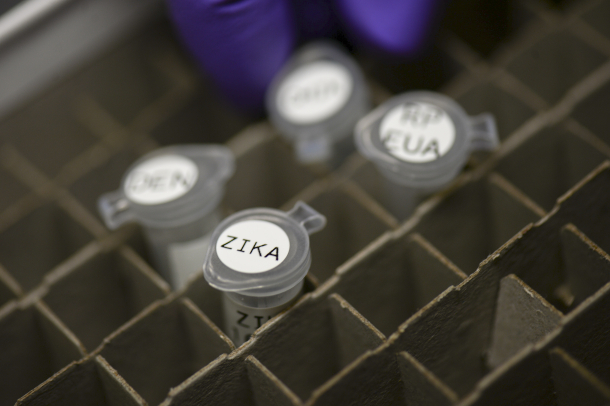
According to the studies past researchers at the World Musquito Programme, infecting mosquitoes with the Wolbachia bacteria can reduce the incidence of dengue, Zika, chikungunya and yellow fever. (Photo: Master Sgt. Brian Ferguson, U.S. Air Force Photo, Flickr CC Past-NC 2.0)
DOERING: So I empathise y'all've tested this first in Australia, and so Yogyakarta, on the Indonesian isle of Java, where dengue is very common. So how did you go nearly testing this in Indonesia?
O'NEILL: Aye, and then we collaborated with a local academy in Indonesia, but also with scientists in other parts of the globe, including UC Berkeley, for statistical assistance with the trial. And we took the city of around 400,000 people and we cut it up into 24 areas. Of those 24 areas, 12, or one-half of them got the Wolbachia release of mosquitoes and the other half didn't. After nosotros let the Wolbachia into the musquito population, and it had established, we then turned on surveillance for disease in healthcare clinics throughout the city. And nosotros were looking to run across the people that came to health care clinics if they were tested and found to exist positive for dengue. Did they live in a Wolbachia expanse? Or did they live in an surface area that didn't receive Wolbachia? And what we found is that in that location was a 77% reduction in the number of dengue cases in people that lived in Wolbachia areas, and an 86% reduction in hospitalizations if y'all lived in a Wolbachia area. We're very delighted about that. But it's good to understand that in this sort of trial design, they're probably an underestimate. And the reason is that, you lot know, even though you might live in a Wolbachia surface area, you lot might non spend your whole time at that place, yous might go on your motorbike and go across into a neighboring surface area to become have your child to school or to become to the market and you could grab dengue there. So we remember that the true impact we're having on things is bigger than the 77%, nosotros measured. And we've now covered the whole city, nosotros've filled in the command areas so that all the people within Yogyakarta got to do good from it, from the intervention. And at present nosotros're waiting to see with the big coverage, whether nosotros actually eliminate dengue manual completely from Yogyakarta in upcoming years.
DOERING: So how did you actually gain the customs'southward trust? I mean, y'all were proposing to release live mosquitoes right next to their homes with this bacterium that perhaps you know near people don't haven't have never heard of don't know much virtually.
O'NEILL: Nosotros spent a lot of time doing engagement with communities, talking to communities about what we're doing, listening to their concerns and answering those concerns. And when we work in an authentic manner with communities, nosotros discover that communities are very supportive. And I call back office of the primal reason for that is that people are fearful of dengue and fearful of their children getting sick and potentially dying of dengue, and non really having any effective treatments at the moment. And so given that take a chance, people seem to be quite willing to try out something novel.
DOERING: Right, I understand Dengue fever is a pretty serious affliction. What is it like when someone comes down with this?
O'NEILL: It tin can exist terrible for people. If it doesn't kill you lot, which it does to many people, you know, it's a spectrum of disease, sort of, like we're seeing with COVID. You know, some people die, and some people accept mild illness, it's the same with dengue. If you lot have a bad dose of information technology, you lot know, you have these piercing headaches, take a metallic gustatory modality in your mouth, a rash on your body, y'all're vomiting, y'all can't exit of bed to get to the toilet. People will depict it as i of the worst couple of weeks of their lives. Then it's quite devastating for communities, hospitals fill up people can't become to work. It has a big social and economic costs as well equally a direct health cost.

In 2016 Wolbachia-carrying mosquitoes were released over a six-month menses throughout parts of Yogyakarta, Indonesia. After several years of trials rates of dengue were 77% lower in the research areas compared to areas that did not receive mosquitoes. (Photo: Main Sgt. Brian Ferguson, U.South. Air Force Photo, Flickr CC Past-NC 2.0)
DOERING: So how likely do you retrieve information technology is that Wolbachia could someday help completely eliminate dengue?
O'NEILL: Well, I think we're probably going to need multiple tools. You lot know, information technology's such an entrenched problem, upwardly to 400 million people being infected every year, all the top major tropical cities of the earth at risk of dengue. Probably whatever i tool past itself may non be sufficient to completely eliminate, simply a combination of tools and a concerted effort to work on dengue elimination, I think we should be able to make great headway in the future to reducing illness. Certainly, where we're releasing more back here and putting information technology out, we're seeing elimination of local disease, nosotros'd dear to come across the methods scaled up enormously around the world to benefit communities. And and then we're hopeful that in the coming years, we'll see an expansion but just because of the size of the trouble, it'south going to take many years.
DOERING: Scott O'Neill is the founder of the World Musquito Program. Thank you so much, Scott.
O'NEILL: Yeah, y'all're very welcome. Cheers for having me on.
Links
The Atlantic | "A Pivotal Mosquito Experiment Could Not Have Gone Amend"
Nature | "The Mosquito Strategy that Could Eliminate Dengue"
Learn more almost the Wolbachia-mosquito studies carried out by the World Mosquito Program
Source: https://loe.org/shows/segments.html?programID=21-P13-00035&segmentID=4
0 Response to "Got a Reason for Living Again Mp3 Agape Force"
Post a Comment